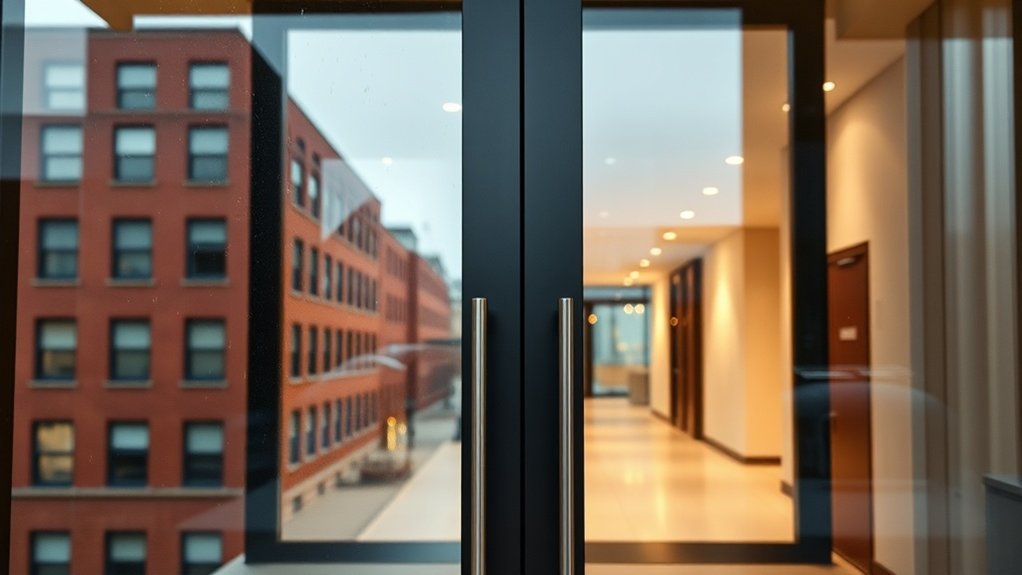
Glass doors in Heathrow let far more daylight into a property, make rooms feel larger and, with the right glazing in a thermally broken frame, keep heat in rather than letting it escape. We supply and fit sliding, bi-fold and pivot systems for houses, flats, shops and offices, with PAS 24 locking, laminated safety glass and acoustic units where the site needs them. This page covers how to choose, what the regulations ask for, what drives the price and how to keep the door working well.
Key insights
- Sliding doors suit narrow plots, bi-folds give a full-width opening to the garden, and pivot doors make a statement entrance; each has different frame and threshold requirements.
- Any glass door must use toughened or laminated safety glass to BS EN 12600, and doors on escape routes or commercial entrances also need to satisfy Part M clear-opening widths.
- Replacement external doors in England must meet the Part L U-value limit of 1.4 W/m²K; argon-filled low-E units with warm-edge spacers get you there comfortably.
- In Heathrow's conservation areas and on listed buildings, slimline steel or aluminium frames with heritage sightlines are far more likely to win planning approval.
- Frosted, reeded and switchable glass solve privacy on overlooked plots and busy frontages without giving up natural light.
- Price is driven more by glass specification, hardware and fabrication tolerance than by the size of the opening.
Benefits of Glass Doors for Heathrow Homes and Businesses
A solid timber or composite door blocks light and view; a glazed door brings both in. On a 1930s semi in Heathrow with a kitchen extension, swapping French doors for a wide sliding or bi-fold set is often the one change that makes the back of the house feel finished, and modern low-E glazing means the extra glass carries no heating penalty.
At home, the biggest difference is how rooms connect. A level threshold between kitchen and patio removes a trip hazard and suits pushchairs and wheelchairs. Shops and offices on Sipson gain differently: a clear glazed entrance shows the interior from the pavement and can take automatic operators or access control to manage who comes through.
The fitting matters as much as the product. A door levelled properly, hung on hardware rated for its weight and sealed against the frame will run smoothly for decades, hold its acoustic and thermal ratings, and accept smart locks or building management wiring later without replacement.
How to Choose the Right Glass Doors in Heathrow
Choosing glass doors for a Heathrow property is a trade-off between looks and performance through a wet winter and a warming summer. The glass unit sets the U-value, solar gain and noise reduction; the frame sets sightline, strength and lifespan. Both must suit the plot, the orientation and the planning situation.
In a conservation area, speak to the council's planning team before ordering. Many refusals come from frames that are too chunky or finishes that clash with the street, and a pre-application chat usually tells you what the officer will accept.
- Glass units with U-values and g-values matched to the orientation of the opening
- Toughened or laminated safety glass, with a security interlayer where needed
- Locks, hinges and closers that work with any planned access-control kit
- Frame profiles slim enough for conservation area guidance
- A local fabricator who can supply spares and service the door after installation
Glass Door Styles for Heathrow Homes
Most Heathrow homeowners choose between sliding, bi-fold and pivot. Sliding doors use the fewest frames per metre of glass, so they suit a narrow Victorian terrace garden where width is scarce. Bi-folds stack to one side and open the whole aperture, ideal for a rear extension that becomes a dining and garden space in summer. Pivot doors are usually one large leaf and work best as a contemporary front entrance.
For a full refurbishment we often suggest a large-format pivot door in a thermally broken aluminium frame with argon-filled low-E units, which clears the Part L target comfortably. On tightly packed streets, reeded or acid-etched glass keeps the light while blurring the view. Laminated panels can also be printed or etched with a pattern, provided the finished unit still carries a BS EN 12600 classification for the zone it sits in.
Glass Door Options for Heathrow Shops and Offices
Commercial glass doors in Heathrow have to do more than look open and inviting. Shop owners want a frameless look, insurers want proof of security glazing, and Building Control wants safety glass and compliant manifestation. We specify glass thickness, patch fittings and locking to the relevant British Standards first, then look at how the door can carry your branding through etching, ceramic frit or printed film without weakening it.
Frameless Shopfront Glass
A frameless entrance is, despite its appearance, one of the most heavily engineered things on a high street. The glass carries the load, so the leaf is typically 12 mm toughened or a laminated equivalent, with fittings rated for the weight and the daily cycles of a busy shop. The payoff is a whole frontage that works as a display window.
The hardware can be almost invisible: floor springs below finished floor level, patch fittings clamping top and bottom, an overhead closer hidden in the transom. We measure to the millimetre and fabricate channels to suit the existing brick or stone, which matters on Heathrow's older parades where nothing is square.
- More visible display area from the pavement
- A clean, modern look that suits premium retail
- More daylight reaching the back of the shop
- Easy to adapt when the interior is refitted
- An uninterrupted route from street to shop floor
Security And Safety Glazing
Securing a glazed entrance without shutters starts with the glass. Laminated glass holds together when struck, so an intruder faces a cracked but intact sheet rather than an open hole, and the interlayer also damps traffic noise. Toughened glass resists impact and breaks into small granules if it fails. Both can be classified under BS EN 12600 and both meet an employer's duty of care.
On Heathrow's conservation parades we fit slimline laminated units that keep the thin sightlines a conservation officer expects. The same logic continues inside: laminated glass for meeting rooms, back offices and anywhere cash is handled. Add floor springs, lock rails and a reader or keypad and the entrance becomes a secure but transparent envelope.
Branding With Glass Doors
Once the glass meets the safety and security baseline, it becomes a surface you can use. A glazed door is the first thing a customer touches, and it is on show from the pavement all day and night. We plan the branding around the sightlines, the interior lighting and the way people move through the entrance so the graphics work from outside without blocking the view in or shortening the life of the glass.
- Sandblasted or acid-etched logos that cannot peel or fade
- Printed interlayers inside laminated glass for full-colour artwork
- Switchable glass that turns opaque for after-hours messaging or privacy
- Body-tinted or laminated colour glass matched to your brand
- Pulls, patch fittings and closers finished to match your shopfit
Get the performance spec signed off first, then layer the graphics on top so nothing conflicts with manifestation rules or accessibility guidance.
Custom vs Off‑the‑Shelf Glass Doors: Cost, Fit and Design
Stock glass doors are cheaper and quicker, and for a standard-sized opening in a new-build flat they are often the sensible choice. The compromise is that the sizes are fixed, the hardware range is limited, and decorative options are few. If your aperture is a regular rectangle and you simply need a reliable, compliant door, an off-the-shelf system from a good manufacturer will do the job well.
A made-to-measure door earns its premium when the opening is irregular, as it usually is in a Victorian or Edwardian house in Heathrow, or when you need concealed closers, access-control preparation or a finish matching adjoining frames. The higher price pays back through fewer remedial visits, better draught and sound sealing, and a door that fits the building. We produce a door schedule from survey measurements so you can see the cost difference before committing.
Safety Glass Choices and Local Regulations in Heathrow
Safety glass is not optional in a door. Approved Document K lists the critical locations, which include any glazing in a door and in side panels within 300 mm of the door edge, up to 1500 mm from the floor. There the glass must be toughened, laminated or otherwise classified under BS EN 12600. The choice between the two then rests on post-breakage behaviour and whether you want security or acoustic gains from an interlayer.
Usage matters too: a school or café entrance takes far more abuse than a garden door on a quiet cul-de-sac, and the glass, edge work and fixings should reflect that.
- Identify every pane that falls within a Part K critical location
- Weigh toughened against laminated for post-breakage behaviour
- Choose interlayers that add sound reduction, UV filtering or attack resistance
- Detail patch fittings and hinges so they do not stress the glass edges
- Ask the supplier for test certificates rather than taking the rating on trust
Planning Permission and Building Regulations for Glass Doors in Heathrow
Replacing a door like for like on an ordinary house is usually permitted development, but many Heathrow streets sit inside conservation areas or carry an Article 4 direction. A new door on a principal elevation there, or on any listed building, will generally need a planning application with frame drawings and finishes.
Building Regulations apply separately whenever a door is replaced: safety glass in the right zones, guarding where there is a drop beyond the threshold, a thermally compliant unit, and on commercial premises the Part M clear-opening width and level threshold. On an escape route the swing and hardware must let people out without a key.
We notify Building Control through our registration scheme and can prepare the drawings a planning officer expects. Agreeing the detail early beats resubmitting after a refusal.
Glass Doors, Heathrow’s Climate and Energy Performance
Heathrow gets long grey winters and, increasingly, hot spells in July and August. A large glazed door facing south or west can overheat a room if the glass is chosen on looks alone, while a north-facing one needs the lowest U-value you can afford. The right unit balances the three numbers that matter: U-value for heat loss, g-value for solar gain and light transmittance for daylight.
Think of the door as part of the building's heating and cooling strategy rather than a hole in the wall. Modern coatings, sensible overhangs and some automation can turn a potential problem into a net gain.
- Pick the glass unit by its published U-value, g-value and light transmission, not the brochure photo.
- Use a solar-control low-E coating on south and west elevations to tame summer gain.
- Keep the frame-to-glass ratio low so the weakest thermal element is as small as possible.
- Check how the sun tracks across the opening in June and December before fixing the design.
- Add motorised blinds or brise-soleil linked to a sensor if the room is prone to overheating.
Energy‑Efficient Glass Doors to Reduce Heating Bills
A glass door only lowers heating bills if it is specified as a building component rather than a feature. The replacement limit in Approved Document L for England is a U-value of 1.4 W/m²K; a good argon-filled low-E double unit with warm-edge spacer achieves around 1.2, and triple glazing can reach 0.8. Ask for the whole-door figure, not just the centre-pane value.
The frame must not undo the glass. Aluminium and steel conduct heat, so insist on a thermally broken profile. For period homes in Heathrow where a heavy frame would look wrong, slim thermally broken steel or aluminium sections now combine narrow sightlines with modern thermal performance and good air tightness.
Orientation finishes the picture. A south-facing door with a moderate g-value collects useful winter sun that offsets heating, provided there is some summer shading, so the new door can cut annual heating demand rather than add to it.
Privacy Solutions for Glass Doors in Busy Heathrow Areas
Busy parts of Heathrow, from the main road to overlooked back gardens, need glass doors that give privacy without darkening the room. Fixed treatments such as etching, frosting and tinting give permanent screening at low cost. Switchable films and integrated blinds give control on demand, so a door can be clear in the morning and private for a meeting. Many projects use both.
Frosted And Tinted Glass
Frosting and tinting let you tune how much people see and how much sun gets in, useful on a reception facing the street or a ground-floor flat door onto a shared courtyard. Factory acid-etching is the most durable; applied film is cheaper and reversible; body-tinted glass shifts the light colour slightly but cuts glare and heat well. All three combine with a laminated construction for safety and sound.
- Fit solar-control tinted glass to south-facing shopfronts to lower cooling costs and protect stock from UV.
- Etch a pattern or logo into the frosted band on a reception door to tie in with the interior.
- Add manifestation decals at the heights required for visually impaired users under Part M.
- Run a gradient frost from solid at the bottom to clear at eye level so displays stay visible.
- Specify laminated tinted units on main roads to knock back traffic noise as well as glare.
Smart Films And Blinds
Switchable glass goes a step further. A PDLC or SPD interlayer turns a clear door opaque when a switch, timer or sensor tells it to, and the film version retrofits to existing panes. Heathrow offices use it on meeting-room doors, clinics for patient privacy, shops to blank the window after closing. Control can run from a wall switch or a building management system.
Blinds still earn their place for glare. Motorised blinds can sit in a ceiling pelmet or the frame, and integral blinds sealed inside the glass unit never need cleaning. Link blinds and film to occupancy sensors or a room-booking system and the door stays clear when the room is empty and goes private when it is in use.
Security Features for Glass Doors in Heathrow Properties
Glass is seen as the soft target in any building, so a glass door must resist forced entry as well as everyday knocks. The glass does the first job: a laminated unit with a PVB or ionoplast interlayer stays in the frame when attacked and slows an intruder considerably. Frame and locks do the rest. We fit doors to PAS 24 or Secured by Design standards as standard, and most insurers now expect one or the other.
- Laminated or toughened-laminated glass with a security interlayer
- Multi-point locking certified to PAS 24 or approved by Secured by Design
- Hinge bolts and reinforced aluminium or steel frames to stop the leaf being lifted out
- Keypads, card readers or phone-based access control built into the door
- Shock, contact and glass-break sensors wired to the alarm panel
Glass Door Prices in Heathrow and What Affects Them
The size of the opening is a smaller part of the price of glass doors in Heathrow than most people expect. What moves the number is the specification: annealed, toughened or laminated glass, the acoustic rating, the U-value and whether the unit needs a security classification. Low-iron glass for a true colourless look, or a thick laminated unit for a shopfront, sits at the upper end.
Hardware is the next variable. A basic lock and handle costs little; a multi-point lock, automatic operator and integration with an access-control system can add more to the bill than the glass itself.
Fabrication complexity also counts. Oversized panes, polished or bevelled edges and the tight tolerances needed for minimal frames all add workshop and site time. Lastly, planning conditions in parts of Heathrow, plus the requirements of Part L and Part Q, can push you towards a higher-performing product than you first planned, which raises the upfront price but lowers running costs and insurance risk.
Designing Glass Doors for Heathrow’s Period and Modern Buildings
Heathrow mixes Victorian terraces, inter-war semis, converted industrial buildings and new apartment blocks, sometimes on one street. A glass door has to sit comfortably against whichever fabric it meets, from soft red brick to a curtain-wall system. We study proportion, sightlines and junction details so the new element reads as considered rather than bolted on, and choose glass, frame and finish to suit the building's age and the performance needed.
Respecting Architectural Heritage
Glass is usually thought of as modern, but in Heathrow it has to bridge the area's industrial past and its newer developments. On a listed façade or in a conservation area a glass door becomes part of the building's story, and a conservation officer will judge it on whether it respects the rhythm of the elevation as much as on how it performs.
Every design we put forward is tested against the street's character, the council's guidance and the technical standards the door has to meet:
- Line up new frames with the original transoms, mullions and shopfront bays
- Choose low-iron or lightly tinted glass so the brick and stone behind stay visible
- Use slim frames in a colour matched to historic paintwork or metalwork
- Pick handles and pulls that echo period ironmongery in proportion and finish
- Specify acoustic, thermal or solar glass without adding visual bulk
Blending Old And New
A well-designed glass door acts as the hinge between the old building and the new work, rather than a jarring break. The aim is a controlled meeting of historic brick, proportion and sightline on one side and the openness and performance today's occupants expect on the other.
We begin by recording the features that set the rhythm: arches, cornices, mullion spacing. The door's size and subdivision are drawn to respect that rhythm, and simple 3D modelling checks the view from the street, daylight reach and privacy before anything is fabricated.
Conservation officers respond well to early contact backed by images. A before-and-after visual, a note that the work is reversible and minimal junctions with the old fabric tend to speed approval and give an entrance that still makes sense in thirty years.
Materials, Frames And Finishes
Good geometry fails if the materials are chosen carelessly. Frame sightlines, the thermal break and the coating system need pinning down at drawing stage because they decide performance and lifespan. Heathrow's rain and traffic pollution are hard on exposed metal and glass edges, so durability is designed in through laminated or toughened units, low-E coatings and properly worked edges.
- Use thermally broken aluminium or steel frames with weather seals tested to the relevant standard.
- Choose a polyester powder-coat or anodised finish keyed to the surrounding brick or cladding.
- Add pattern or branding through ceramic frit, printed interlayers or laser etching.
- Select stainless steel or PVD-coated hardware so it does not pit or tarnish.
- Detail the threshold and drainage so water runs away from the frame base and the glass edge.
Glass Door Maintenance in Heathrow and Early Problem Signs
Regular maintenance keeps a glass door safe, smooth and compliant. Match the interval to how hard the door works: a shop entrance on a Heathrow high street may need a check every six months, a garden door at home once a year. Each visit should cover the torque on patch fittings and hinges, closer speed and latching, and whether the manifestation and safety markings are still legible.
Catching faults early is cheaper than replacing glass. Watch for chips on the edges, a leaf that drags at the threshold, a frame gone out of square, or an operator that hesitates. Grinding from a pivot or roller usually means a worn bearing. Milky patches in laminated glass point to delamination, and misting between panes means a failed seal. We log every service visit and repair with manufacturer parts so warranties stay intact.
Find out more about our Heathrow glaziers and the other work we do locally.
Frequently Asked Questions
Can Glass Doors Help Reduce Noise From Heathrow’s Busy Roads and Nightlife?
They can, if the unit is built for it. Standard double glazing gives some reduction, but an acoustic laminated unit, with panes of different thicknesses and a sound-damping interlayer, performs far better against traffic and late-night noise. The frame has to match: a thermally broken profile with good compression seals stops sound leaking round the edges. Ask for the unit's Rw rating in decibels and compare it with what you have now. On a main road in Heathrow the difference is noticeable from the first night.
How Long Does Professional Glass Door Installation Usually Take in Heathrow Properties?
A single replacement door in an existing opening usually takes half a day to a day. A wide bi-fold or sliding set needing a new lintel, level threshold and drainage channel is typically a one- to two-day job, and a frameless shopfront with floor springs can take longer because the floor must be prepared. Survey and manufacturing lead time come first, often two to six weeks depending on the system. We confirm the programme at survey so you can plan around it.
Are There Eco-Friendly or Recycled-Material Glass Door Options Available in Heathrow?
Yes. Float glass already contains recycled cullet, and several manufacturers offer aluminium frames made largely from recycled stock with far lower embodied carbon than virgin metal. FSC-certified timber frames suit period homes. On the performance side, a low-E, argon-filled unit with warm-edge spacers reduces operational carbon for the life of the door. If sustainability matters to you, ask for the Environmental Product Declaration for the frame and glass so you can compare like with like.
Do Heathrow Installers Offer Warranties on Both Glass Doors and Installation Work?
Reputable installers in Heathrow should. The manufacturer typically guarantees the glass unit against seal failure and the frame finish against fading, often for ten years, with hardware covered for less. The installer gives a separate guarantee on the fitting, covering alignment, sealing and operation. Ask for both in writing, check the exclusions and whether cover transfers to a new owner. A FENSA or similar registration adds an insurance-backed guarantee if the installer stops trading.
How Do Glass Doors Affect Home Insurance Premiums for Heathrow Homeowners?
It depends on what you fit. A door with laminated glass, a multi-point lock to PAS 24 and a certified frame counts as a security improvement, and some insurers reflect that in the premium or at least do not load it. A large glazed opening with basic hardware and no accredited rating can go the other way. Keep the specification sheet and lock certificates, tell your insurer before the work starts, and ask whether they require particular standards. Ten minutes now avoids a dispute at claim time.
Summary
The right glass doors for a Heathrow property bring in light, open up the view and, specified properly, improve security and cut heating costs at the same time. Match the glass to the opening, the hardware to the risk and the frame to the building, and the door will give years of trouble-free service. For a free survey and written quote for glass doors in Heathrow, call us and we will arrange a visit.